Why would 1,300 square feet on Chambers Street cost more per square foot than a single-family home three miles away?
That's the question worth sitting with before you tour a single unit downtown. Listings there carry a median price around $489,000 right now. A recently sold two-bedroom at 360 Chambers Street closed at $308 per square foot, according to its own sale record. Across Woodstock as a whole, homes were listing at a median of $224 per square foot in August 2026. That gap has nothing to do with square footage, and everything to do with three things buyers rarely price in before they write an offer: how long the asset actually takes to sell, what the monthly fee is quietly funding, and how much new supply is already working its way through City Hall.
The Long Wait Nobody Mentions at the Open House
Here's the number that should reframe the whole conversation. Right now, condos within the tighter "Downtown Woodstock" boundary carry a median time on market of 176 days. Widen the lens to the broader "Woodstock Downtown District," which folds in more of the surrounding condo and townhome supply, and that climbs to 224 days. Compare that to Woodstock as a whole, where homes are currently taking a median of 83 days to sell, and the downtown product is moving at roughly half that pace, sometimes slower.
You're not paying a premium for a faster sale. You're paying a premium for a smaller pool of buyers who want exactly this product in exactly this location, and a longer runway if you ever need to sell. The broader market has cooled too. Woodstock's median sold price across all home types was $477,761 in July 2026, down 5.9 percent from a year earlier, so the extra wait for a downtown condo is happening inside a market that is already softening, not one running hot enough to absorb it quickly.
That matters for two different readers in two different ways. If you're buying to hold for years, the slow absorption rate is background noise. If you're buying with any chance you'll need to sell inside a five-year window, it's the single biggest variable in your plan, and it deserves more attention than the granite countertops.
What the Extra Money Is Actually Buying
Walkability is real here, just smaller than the marketing suggests. Downtown Woodstock carries a Walk Score of 53, more than double the citywide score of 21 for Woodstock as a whole. That's a genuine, measurable jump. It also means you're still in "somewhat walkable" territory, not the errand-free urban core the listing photos imply. You can walk to dinner. You'll still drive to the grocery store most weeks.
The other thing your money buys is proximity to jobs, not just neighbors. Downtown Woodstock is home to an estimated 830 residents and roughly 4,007 jobs packed into the same small footprint. During business hours, this is a working district first and a residential pocket second. That daytime density is exactly what fills the restaurants and keeps the sidewalks busy, and it's also why so much of what you're buying is access to a commercial hub rather than a large, established residential community.
The Building That Set the Price Floor
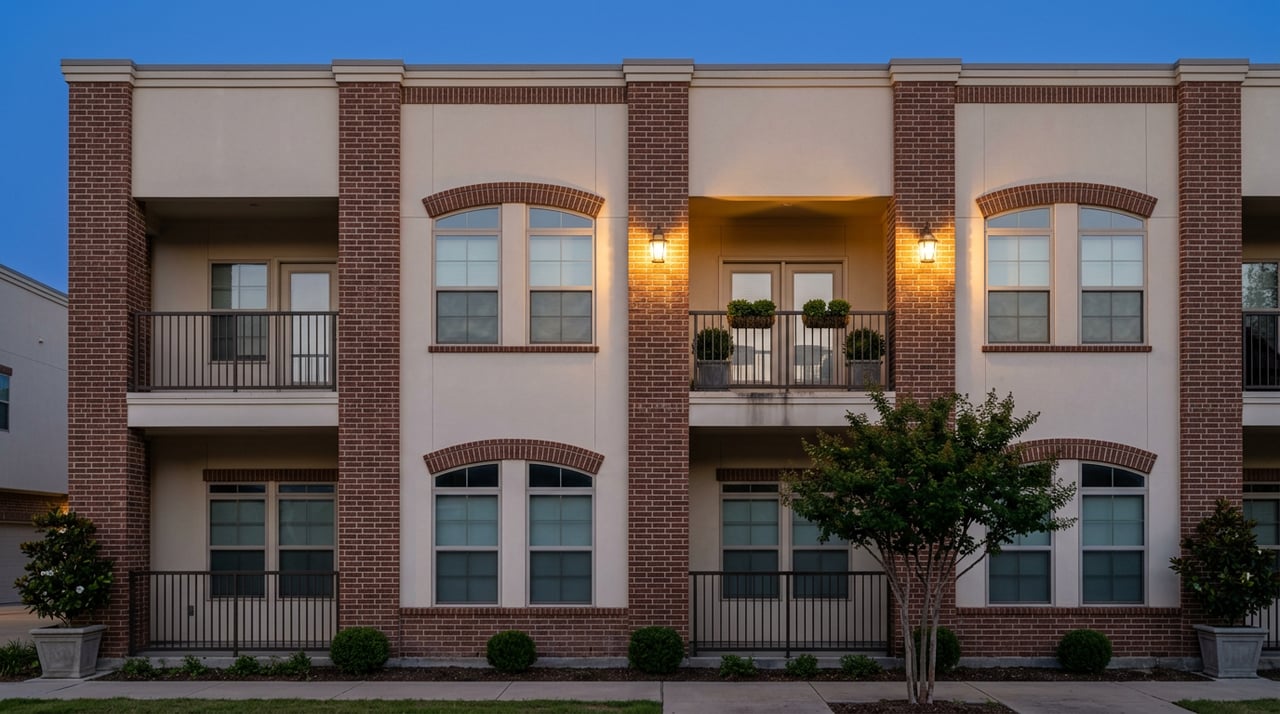
Most of what's for sale downtown traces back to one address: 360 Chambers Street. Completed in 2005, the five-story building holds 198 condominium units, a mix of brick and stucco with arched windows and recessed balconies, and it's the building most agents mean when they say "downtown condo." One recently sold two-bedroom there closed with a monthly HOA fee of $465 and annual property taxes of $3,098, at a sale price working out to $308 per square foot. Building-wide, monthly HOA fees run $400 to $500, covering exterior maintenance, ground upkeep, reserve fund contributions, and access to the community pool.
Annualized, that's roughly $4,800 to $6,000 a year before a single repair, tax bill, or mortgage payment. Some of that buys real convenience. Some of it is simply the cost of shared walls and a shared roof in a building now past its twentieth year, which is exactly the point in a condo's life cycle where reserve studies and special assessments start to matter more than they did at year five.
The New Address Competing With the Old One
Half a mile up Main Street, a newer product is entering the same price conversation from a different direction. Adair Park, positioned at Main Street and Linton Street, is building new-construction luxury condos with features the 2005-era stock doesn't have: private elevators shared with as few as two neighbors, two-car private garage parking, 11-foot ceilings, and in at least one unit marketed as the Broadwell Residence, a rooftop terrace with its own hot tub. New Home Source lists the broader Adair Park community's base pricing at $768,000 to $3,600,000 across its mix of home types, a range that signals just how far the ceiling has moved since 360 Chambers Street set the original comps.
That's not a knock on either building. It's a reason to ask, before you compare two units by price per square foot alone, which era of downtown construction you're actually buying into and what that means for insurance, HOA reserves, and resale comparables five years from now.
The Pipeline That Could Move the Math Again
Supply is still arriving. Woodstock's own planning department shows a case, filed on behalf of the JW Collection, requesting approval for 73 townhomes plus 6 residential units above commercial space at the corner of South on Main Drive and Main Street, a total of 79 additional residences. That project moved through a City Council hearing on July 27, 2026.
Separately, Adair Park itself has another expansion working through the same process. A case filed on behalf of Adair Park Development Company LLC, covering parcels at 7950 and 8020 Main Street, is scheduled for a Planning Commission review on October 1, 2026, followed by a City Council vote on October 26, 2026. You can track both cases directly through the city's public hearing case list.
None of this means values are about to fall. It does mean that anyone buying downtown right now, expecting the current scarcity to hold, should factor in that the supply picture is not static. More product on Main Street, arriving in phases over the next year or two, changes the competitive set for anyone reselling in that window.
What This Product Actually Costs vs. Comparable Space Elsewhere
| Downtown Woodstock Condo | Woodstock Citywide | |
|---|---|---|
| Median list price | ~$489,000 (current listings) | $477,761 median sold, all home types (July 2026) |
| Price per square foot | $308 (360 Chambers St., recent sale) | $224 (August 2026, listed) |
| Median days on market | 176 to 224 days (current listings) | 83 days (current listings) |
| Monthly HOA | $400 to $500 (360 Chambers St.) | Varies, often lower or none |
| Walk Score | 53 | 21 |
Questions Worth Asking Before You Write an Offer
- Ask for the building's most recent reserve study, not just the current HOA fee. A healthy reserve fund now prevents a surprise assessment in three years.
- Ask how long the specific unit type you're considering has actually taken to sell in that building, not the neighborhood average. A one-bedroom and a three-bedroom penthouse do not move at the same pace.
- Ask whether the HOA covers structural items like roofing and siding, or only common grounds and amenities. That distinction determines who pays when the building needs a new roof.
- Ask your agent to pull the current status of any pending zoning cases within walking distance. New supply a block away affects your resale comparables whether or not it affects your daily life.
Frequently Asked Questions
Is a downtown condo a worse investment than a single-family home elsewhere in Woodstock? Not necessarily worse, just different. You're trading a longer expected time to sell and a fixed monthly fee for walkability and a lower-maintenance lifestyle. Whether that trade works depends on how long you plan to hold the property and how much you value not mowing a lawn.
Why does the same neighborhood show different days-on-market numbers depending on the source? Different platforms draw the "Downtown Woodstock" boundary differently. A tighter boundary around the historic core will show different absorption numbers than a wider one that includes more of the surrounding condo and townhome inventory. Always ask which boundary a given statistic is using before you compare it to another source.
Will the new construction at Adair Park make older buildings like 360 Chambers Street harder to sell? It's too early to say with certainty. New product typically resets the top of the price range rather than pulling down existing comps, but it does give buyers more choices, which can extend time on market for older inventory competing on price alone rather than on newer finishes.
If you're weighing a downtown condo against a single-family home elsewhere in Woodstock, the price per square foot is only the opening number. The full picture includes the fee, the timeline, and what's still coming up Main Street. Broadus Realty Group works this market every week and can walk you through the specific building, HOA history, and pending development cases that actually apply to the unit you're considering. Reach out to start that conversation before you write an offer, not after.